Tuesday, March 13, 2018

DAM DICTIONARY

DAM DICTIONARY
Copyright 2018 by Lori-Ann Willey 

A list of words we use around camp since our purchase in 2004.  I'm sure I've missed some, but as we use and remember, I'll add to the list.


COMMONLY USED WORDS / PHRASES / REFERENCES

16-Mile Loop -  Trip we make with snowmobiles or our Polaris 4-wheeler to our truck and back during the winter months.

A FUNNY -  A telling of an amusing experience.

A Stiffel - A process of building using more nails than wood.

Allen's-way - A clever way of doing a complicated or cumbersome task.

Aunt Flo -  Monthly period.  AKA - Aunt Dot

Baby X -  A temporary name for an unborn child.

Bedspread -  What one creates when they sprawl out on the bed leaving no room for the other.

Big People's Drink - Any alcoholic beverage.

Big Potty - Composting Toilet

Bladdah-Gladdah - What you do when you go pee.  You make your bladder gladder.

Bob Hope - A specific husband/wife in the cove.

Bubbles - Snow. (Ellie)

Cannable vs. Cannible - Paul wondered if eels were cannable.

Cheatah Pizzah - Store bought pizza

Climatized - When you are used to it being cold out.

Cling-Ons - What you call little kids when they cling to you.

Coffee Burner - The process in which green coffee beans are roasted.

Coffee Pot -  The Luggable-Loo with deodorizing coffee grounds.

Cordon-Blue - The heating cord is on the face shield  of the blue snowmobile helmet, therefore, cordon-blue.

Cuskasaurus - Cusk fish that is larger than average size. (Bruce -Katahdin General)

Dam Camp Husband – Paul

Dam Camp Wife – Lori-Ann

Dam Hill - Hill going up from the dam.

Dangling Participles - What I told Paul to watch for when he wears boxers (without snaps) ..."Dangling Parts-visible".

Deep-Throat - When a fish takes the hook, line and sinker deep in the throat.

Dickles  - A mixture of  Wickles (red relish) & Dill (green relish)

DOH!ment - The moment you realized your previous thought was a "DOH!"

Dolby - Way out to town in the winter.

Double-Dipping -  Fishing with two poles at once.

Downers - Ice Fishing:  When you lower the bait to the bottom.

Drive-By-Shooting - What we do when friends come within picture shot while on the lake with our boats.

Drop ‘em & Go -  Act of going pee outside.

Eagle -  Name of an island where we often see eagles.

Eelin' - Eel fishing.

European - What the other spouse says when the other is peeing (You're-ah-peeing)

Fat Jumpers -  Little, jumpy, hard bumps on snowmobile trails where sledders drastically increase speed, leaving snow sprayed and heaped in the trail! 

Fishit - 1.  What comes out of a fish when you clean them. 2.  What you do in a stream...fish it. 

Fishy-Fit - What you have when you pull up a lake chub thinking it was a big trout.

Four Corners - The point where the Stacyville Road and Huber Road meets.

Going Horizontal – Time for bed.

Goofy - Way out to town in the summer.

Go-Postal - What we say when we need to make the one hour round trip to the Post Office in Summer.  A good 30-45 minutes longer than that in winter.

Gray Water – Drainage water -washing, cleaning, dishes, etc.

Green-Eye - An underwater fluorescent green light used for night fishing.

Gunky Potty - Litter Box

Guzinta - This "goes into" that.  Also known as a, "Guzinta problem". 

Hangover - When sleeping at the Gateway (Hotel in Medway), we always wake up with a hangover.  (Feet hanging over the end of a double sized bed.)

Hip Fart -  The noise your hip makes when it pops back into the socket! (Florice)

Holy-Hannah! - What is yelled when you catch a small fish, and want everyone to think you caught a big one. (Dave)

Hopper-Hop - What we do in the bathroom in the winter.  The Luggable-Loo is for going #1, and the composting toilet is used for going #2.  

I'm on! - Statement to indicate being "online" or "connected" to the Internet.

Ima – “I’m a ….”

In the Now -  What's happening at that very moment. (often showing a picture)

IVIG -  Immuno gamma globulin “treatments”

Jumping-off-rock - The pyramid-shaped rock to jump from while swimming. (Stiffel’s)

Kinky Fish - The fish that are attracted to the vibrations of the snowmobile upon the ice.

Lap Dance - What your paper plate does when your lap tries to hold it during the eating process!

Lap-It  - When you do a Lap Dance

Lips - Anything that goes on the lips.  "My tongue took my lips away."  (What Autumn said after she licked chapstick off her lips.)

Lip-Stuff - Lip moisturizers.

Little Potty - Luggable-Loo (Piss Pot, Coffee Pot)

Millinocket Lake Piranha - Sunfish

Mt. K -  Mount Katahdin

Muchcuskluk - When the cusk fishing is good.

M-wow - What the cat (Gunky) says when Josh cleans his room!

Nose Douche - The process of cleaning out the sinuses using a bulb syringe, warm water and salt. (Thea)

Off Eagle - Location of ice shack.

"Peas" and Poops -  The name of Lori-Ann's garden.

Patoot -  Butt

Perchin' - White perch fishing.

Pink Medicine - What kids hope for at each doctor visit. (liquid Amoxicillin).

Quimby - A 6-letter swear word.

Sea Turtle -   Big snapping turtle

Silly Poop - Poop that is shaped like a “j” . (Ellie)

Squeepee -  (or Squeepy)  That last-ditch attempt to squeeze out a little "pee" before a trip to town, etc, in hopes you won't have to "go" until you get back. 

Stitch -  Straw or Corn brooms with painted faces.

Strap-ons - Bungee chords

Sunspot - Where the cat and Lori-Ann sit to feel the "warmth" of the winter sun.

The Beast -  Polaris Ranger

The Dam Willey’s -  Paul and I as referenced by others.

The Point - The endpoint on the camp road.

Three-Way - What happens when three fishing lines cast at the same time, in the same spot, then get tangled together, leaving the three fishermen thinking they have fish (Marc)

“Too Pooped to Poop” -  Exhausted

Traumatized - When it's REALLY cold out!

Triponable - Anything at ground level that can cause tripping, therefore it's trip-on-able.

Up Mud - A nice secluded boat ride.

Up Sandy - Going trout fishing.

Uppers - Ice Fishing:  When you lower the bait to just under the ice.

Uppin’attem -  Time to get off the patoot and get stuff done.

Uppinaddah -  When you are up and out of (bed).

Vikings - Those who take Vicodine.

Weeds - Wild Edibles.

Wet Back Hill - Hill on the Stacyville Road that is always wet with water seepage.

Zombie -  In a stupor, too tired to think.


BUILDING REFERENCES

Ami – Shed made by the Amish

Ellie-Aut – Shed named after our granddaughters -Autumn & Ellie

Home-home - Our legal residence.

Little House - Cottage

Pauly – Shed made by Paul and Lori-Ann

Plywood Palace – What our camp was called before we purchased it. (Brian M.)

Telephone Booth – Outhouse


ANIMAL REFERENCES

Ah-Choo – Name of our cat.

Bebe – Red Squirrel

Blurds - When birds get blown around with the snow in wicked high winds, you see blurry birds.

Bob & Bobbette – Raven mates

Caw - A certain seagull that comes to our boat when we yell "Caw".

Chippy - Chipmunks

Cyril – Red Squirrel

Gunky-Butt – The name of our cat.

Hand-Warmer - Name of a still warm dead squirrel.  When cold, it goes into a pot of water.

Jumpy – Red Squirrel

Rainbow – Seagull

Sammy Jay -  Blue Jays (Thorton Burgess)

Snorkeling Bear - A tree stump/root protruding from water.

Target Practice - When red squirrels steal the bird food!

Thal - Name given to a short and stubby red squirrel. (short for Thalidomide, a 1960’s morning sickness medicine, resulting in stunted limbs of the offspring.) 

Tonto - Name of the red squirrel with the tail hairs that stick straight up in the shape of a feather.

Twister - Name of a mourning dove that has a white bread twist-tie around her/her left leg.


IMAGINARY CHARACTERS

Daylight – Teller of outside conditions at dawn.  Bringer of light.

Haste – Helps get stuff done in a hurry

Mother Nature – Mother Earth and all that she holds

Night – Concealer of Daylight. 

Up & At’em – Prodders to get my butt moving

Waste – A time waster


Tuesday, February 20, 2018

PAMOLA - Protector of Mt. Katahdin

PAMOLA -Protector of Mt. Katahdin

Copyright 2018 by Lori-Ann Willey


Mt. Katahdin Summit, Knife's Edge,
and Pamola Peak
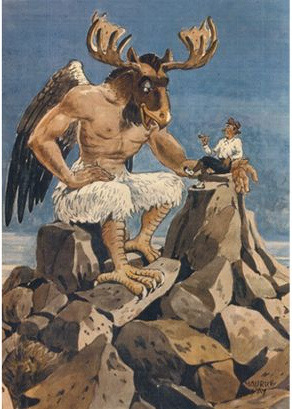
From time to time, I will casually, or even comically mention the name, Pamola.  Those who are familiar with Mount Katahdin,  the history and folklore of the Penobscot Indians know the legend well.  

In accordance with the Penobscot people, Pamola was an evil spirit that roamed the mountain.  He was a Penobscot god of thunder and protector of Mt. Katahdin. Pamola had the body of a man, head of a moose, and the wings and feet of the almighty eagle. 

(An Internet Photo)
It is said that Pamola resided on the eastern peak of Mount Katahdin where he protected to such great extent that those who dared climb to the summit were devoured by the beast itself.  Therefore, those tribesmen never returned.  If you look at the photos below, you see "Knife's Edge" and can certainly begin to understand why people did not return.  

Looks like Pamola is playing
with a ball.  (A Cloud Formation)
I know of many hikers who said they have climbed Mount Katahdin many times, all her trails, and annually, even.  Some, hike during the winter months, though I can't for the life of me understand why.  It is said by many, 'I crawled across Knife's Edge.  I'll never do it again.'  Comments such as, 'I'll never climb Knife's Edge again'.  'All was fine until the wind blew.  I thought I'd fall to my death'. 'The climate is different there.  Even during the summertime, the rocks are iced!'  'I reached Pamola Peak, saw Knife's Edge and turned around. I can think of many other ways I would rather die.'  

Knife's Edge
(An Internet Photo)
Such comments are nerving even to the bravest.  Yet, they also invite a challenge that so many accept.  Yet, I look at Pamola Peak, Knife's Edge, and what I call the summit-summit every day.  While I gaze, I am in awe of the history of the people, the mountain, and of their past.  What will become of Mt. Katahdin, if one day, they install a tramway for tourists?  I've heard of such mention, and, though that would be the only way I'd ever reach the top, or even cross Knife's Edge, I would not be in favor of that obstructed view.  I'm one that enjoys the thought of preservation of nature as she is, and I do not enjoy the thought of my view obstructed by anything except for a passing cloud, rain, or snow.  However, I fear that day will come.  I just hope that it is not in my lifetime.

Trail across Knife's Edge
(An Internet Photo)
The Penobscot Indians believed that Pamola, even at her base, prevented humans from scaling his mountain home.  There are references that even at the base, Pamola stirred up such blizzard-like conditions that were unsurvivable.  So harsh, that hikers could not advance another step.

I must say that I appreciate and enjoy the folklore of the Penobscot people, and so did a man by the name of Leroy Dudley.  His "yarns" are enjoyed by any reader of his book, "Chimney Pond Tales".  His stories are quite amusing, and I must admit, he is an inspiration for me as well.  For, since I read his book, I started a couple of my own.

A few years ago, I wrote a book about a young boy who was to become the leader of his tribe.  The story takes the young boy through trials surviving a harsh storm never before experienced by his people.  Lost, he spends many weeks in search of his tribe.  As a reader, you journey with him. In the book, Pamola is mentioned -evolved around two old women who curse the beast for the loss of their mother as they vow to see revenge.  That book is in the editing process.  I have also started another book that directly involves Pamola as one of the main characters.  Though, well on its way,  that will take a while to write.


The Penobscot people and their Pamola inspired me, but it wasn't until I read Leroy Dudley's book many years ago that set me in motion to write a couple writing pieces of my own.  And, of course, one winter day, I had to "tame the beast", too!

If you chance upon the book, Chimney Pond Tales, it is an amusing read.
My Bookstore
21 books available


Friday, January 12, 2018

A SPECIAL KIND OF CRAZY

Life off Grid

Snow Clean-up – Even in the Cold- Even with the Work Load

Copyright 2018 by Lori-Ann Willey


“Is all that work you have to do to
stay in the woods worth it Laurie?”
-Philippe Page


Paul measuring snow
the depth
Though I could answer Philippe's question with a simple, “Absolutely”. Instead, I will attempt to answer with details and explanation for a better understanding of me as a person and my mindset.

Plain and simple, living life off the grid is a lot of work. I will be the first to admit that, just as I’ll be the first to jump in and get my hands dirty and my body grubby. Simply put, what must be done, must be done. When it comes to needs, there are no ifs, and, buts, or “maybe later” comments. When it comes to wants, then, yes, such words are allowed into my vocabulary, but not until.

I am a need before wants person. It was the way I was raised. Work comes before play was the way I was raised, too. If there is play time left over, that time is cherished and appreciated that much more …a reward for all the hard work of both the body and mind, if you will. It is such a refreshing feeling of, not only satisfaction or appreciation but of a job well done, too. I do not dread the work that comes with this lifestyle because there is a great sense of willingness to do what must be done when it must be done -my mindset- it is a powerful tool. A necessary tool.

Because Philippe asked his question after a few days of winter clean-up, I’ll focus on that topic specifically. Quite honestly, I do not see winter clean up, no matter how many hours over how many days, as a chore, as a dread, or anything of the like. I see each shovelful as a challenge in how to be more efficient. To me, snow clean-up is a form of art. Or, that is how I think of it anyway.

Though my photos may seem like just a pile of snow to others, to me, it is more than that. It is warmth due to "banking" the camp. The snow becomes a platform, too. Each shovel full builds a walking snow scaffold that helps me reach more of the rooftop as the snow depth becomes deeper. With each snowfall means that I can reach more of the roof at a better angle, become more efficient with that 12-foot long roof rake.

My platform is three to ten feet wide “pathway” that serves more than one purpose. 1. A safer area to walk along the full length of the camp, that, as stated above grows in height to make roof raking easier and easier over time. 2. The snow provides “banking”, which in turn helps prevents drafts and that harsh wind from penetrating the camp walls. 3. There are times when I don’t have to use a ladder to access the roof. I use pre-carved snow-steps instead -steps that I work at making stronger with each storm. On the warmer days, dripping eaves not only help solidify those steps, but also make them quite slippery, so I must always maintain them.

Shoveling snow is quite rewarding when, with each shovelful, I know that the end result is an easier access to the roof for the next storm. It is fun to watch the snow pile, and pile, and pile to the point that I can walk right up to the roof as if a set of steps entering a home. It does not take long, no matter how wide I build the platform before the snow reaches the bottom of the camp windows. Then, it is the shoveling the snow away from them, so we can see out, let daylight in, and have each window as an escape route if need be.

Raking the camp roof is just part of the snow clean up. We have three sheds, an extra slanted roof over the coffee roasting area, a cottage, and an ice shack that must be cleared of snow, too. Allowing snow to pile up, flirts with the risk of collapsing under the weight of it all.

If we want to have a light inside the camp the solar panels need to be kept clean. We have ten of them. Two are upon the camp roof. Two are at the end of the dock. And, six are along the shoreline on a not-so-easy-to-navigate slope.  


To access the solar panels is not the easiest task with a bad back and a bum knee -that’s me. Paul, access is much more difficult due to his disabilities. On a good day, if he feels up to tackling them, I try to talk him out of it, while at the same time, I know it is good for him to get out there. I watch him closely in case he needs help along the way. On the heart and mind, it is just easier for me to "beat him" to the task. To more easily access the solar panels, the deck, stairs to the dock, the dock, and then pathways along the slope must always be cleared for walking.

To help make navigating the slope easier, I make snow steps that I diligently maintain throughout the winter. In other words, I terrace (with snow) the landscape for easier navigation. Therefore, a shovelful of snow is never mindlessly tossed anywhere here. Ever. Each toss is planned and placed so over time, navigation is easier, and access is easier, too. Easier on the body as well. Due to the winds blowing snow off the mountain and across the lake, the panels often become buried with snow. Each snowstorm, or windy day, the panels not only need cleaning off to be efficient …or work at all, the drifting snow around them must also be dug out. There is only so far you can throw snow before that snow, too causes drifting, which prompts more shoveling and in a larger area to keep the panels from becoming lost in snow drifts.  Again, snow placement is important.

Because we have the kind of composting toilet that has a holding drum under the camp, that area must be accessible throughout the winter months as well. Unfortunately, due to the landscape, that must be shoveled out even when there are only a couple inches of snow, or the dripping eaves will make navigation there impossible. Each time I clean off the steps into camp, I also shove that area free of as much snow as I can.  Lots of times, it requires a lot of chopping of ice.

As snow builds throughout the winter, our front steps disappear. Because there is a slope to the steps that can become slippery, I also terrace that area, so instead of walking on a slippery slope, we instead walk on snow steps that are wider and deeper than the buried wooden steps themselves. Right now, we are down to five of the six steps. We won’t see the bottom step until the end of April and only then if I chop the snow and ice away to expose them. Usually, by end of winter, all six steps are buried with snow and we exclusively use the snow steps I made throughout the winter months …one step at a time. Literally. (Click to enlarge photos on right.)

Paul, when he feels up to it, keeps the camp yard plowed with “The
Beast”. That keeps the drifting down to a minimum and makes for easier walking to the sheds, and to my compost piles as well. Yesterday, I sat in the Beast with him while he finished plowing. We have large snowbanks already, but the great thing about a tracked beast is that he can push the snow as he climbs the banks and drop the snow over the top. Usually, by winters end, our snowbanks can be 15 feet tall and over 30 feet thick. Those are the snowbanks I appreciate the most because I can climb them to access pine twigs 20 feet off the ground.  I make my own sketching charcoal. When I retreat, like a child, I sit on my butt and slide down.  Those banks sure beat trying to trudge through several feet of snow to the nearest pine sapling! Works for me!

To keep the camp road to the groomed trails navigable, we like to groom the road to keep it smoothed out and useable with snowmobiles and The Beast without becoming stuck. Trust me, when I say that we’ve been stuck with both sleds and that Beast, many, many times over the years. Storm pending, type of snow, and the “feet” of snowfall determine how we manage the camp road.

Not showing where windows
are dug out for natural lighting.
Currently, due to last week’s episodes of becoming stuck twice within 50 feet in huge snowdrifts, we cannot, or have not been able to (yet) finish smoothing out the drifts in the road below us. That 1/3-mile section is our access to the lake for ice fishing. If we are to ice fish this winter, and we want to, we need to first figure out a way to smoothen out the road …and wide enough to drag our ice shack onto the lake. Right now, we cannot (or couldn’t as of a couple days ago), get to the lake if we had to.


Usually, storm pending, we like to clean snow from the truck, around it, and the snowmobile trailer, too. Due to roads into camp becoming snowmobile trails during the winter months, we must park and leave the truck and trailer eight miles away. This means, we either use The Beast or use the snowmobiles to get there. Unfortunately, though we have a plow for The Beast, we cannot travel the trails with it attached. Well, we probably could, but travel would need to be 5-mph the whole way. That 16-mile loop would take far too long to consider the task. Besides, the last mile of trail is quite narrow.  So, instead, we strap shovels and a small portable snow blower to the sleds or to The Beast and use those for snow clean up at the truck.

Depending on the storm, the amount of snow fallen and type of snow, clean-up can take anywhere from a few hours to several hours a day for several days. It can be quite challenging to “keep up with the storms” at times and that is especially so when storms are just a couple-three days apart.

We do not often have sticky snow here during the winter months. But, when we do, no matter how tired I am, my reward at the end of the day is to play in the snow. I love creating and sculpting the stuff when I can. Even when my body is spent, and it is difficult to put one foot in front of the other.  Even when I cannot pick my feet high enough to trudge through the snow without stumbling or falling often I look forward to my sticky snow play time. Often, by then, if my gloves aren’t soaked from the snow clean-up, they are wet inside from sweat, I collect and pat snow into whatever shape that comes to mind.  My fatigue is beside the point.  I can push through.  Playtime is important even to this 51-year old Grammy.

There are times when the snow is not sticky where I like to be creative, so I shovel snow into a tote and drag it to the deck and play with it there, sculpting, carving, grinning and giggling at my silly creations as they form. Fatigue plays a factor, of course. Doesn't it have to?  It seems the more tired the body, the funkier and fun the sculptures are to make. My reward at the end of a long, hard day often takes me into diminishing daylight.  I pout at the loss of it.

Once inside, if Paul is feeling well enough, he’ll have a meal all planned, if not ready to start cooking. Otherwise, I undress, hang my clothes, cool off, rehydrate, and then, prepare suppah. Usually, at the end of those days, it is a quick meal that can be ready within minutes. Other times, I catch my second, third, fourth, fifth, etc. breaths of the day and make a meal that is not so quick to cook. Often, we eat and off to bed before blackness envelops the area on non-snow clean-up days, too. That is another great reward!  Early to bed, early to rise.

Though all that may sound horrible to so many people, it isn’t. I enjoy being outside. I guess snow clean-up is the excuse that I need?  Or, is it a want?

Back to shoveling ...to me, snow clean-up really is a form of art. One that I enjoy and appreciate. Even when I must spend a few minutes brushing the snow off my body from head to toe before entering the camp. And, trust me, often, I look like a Yeti. "RARR!"

I’m not trying to minimize the workload here when it comes to winter living off the grid. Though it is hard work, my body thanks me for it. I feel it getting stronger as my stamina grows, too.  Strength and stamina help me become more efficient with each storm, and that I greatly appreciate.  Snow clean-up is a full-bodied workout and for hours at a time. I love it.

When I stop to rest, catch my breath for a couple of minutes, I often do so in place. I sit down and prop against a tree, or, if I fall, I’ll often just lay in place and rest where I lay. While I rest, I observe my surroundings, whether it be a tree that stopped me from falling further, a rock that about broke my nose, or the pile of snow staring back at me, I study whatever is around me. Whether it be snow fleas, snow texture, or critter tracks. If I happen to be staring up at the trees and sky above me, I watch the clouds, or how the branches grew where they did and why. I am "forever and a day" observing,  theorizing, learning, and appreciating everything around me.  Even the snow!

The view, especially the sunrise is something that I take the time to stop and watch. When the birds approach, I stop and talk to them, allow them to flutter around me, land on me, and talk to me from the nearest branch. I always make time for the critters. Even Bob, the Raven habitually flies over me each time I shovel or rake the roof. He usually speaks first. My reply is usually, “Hi Bob” or “Mawnin’, Bob!” To that, he muffles back at me as he continues onward. Sometimes, he’ll fly in a low circle over me first. Like with the birds and critters, when I stop to rest, I call out to them and see who will visit me first. Bob and the chickadees are usually first, but not always.

There are times when I step (or fall) and sink into the unpacked chest-deep in the snow and am seemingly stuck forever and ever, Amen. So, I consider that act an opportunity to rest a bit. Before I attempt to remove myself from a deep snow imprisonment, I think: 1. How to get unstuck? 2. Scrutinize the workload yet to come, where I need to shovel more snow here, or there, etc. I am always planning -Plan A, B, C, and will figure out D after Plans A, B, and C fail. Where there is a will, there is a way.  Sometimes, it just takes a bit longer to figure things out is all.

I might seem like a crazy person to some, but if I am, I’m crazy enough to love it …knowing better or not. Maybe it takes a special kind of crazy?   In all honesty, what is not to love, cherish and appreciate? Even in the cold? Is all this work worth it? Philippe, with a big grin from me to you, I say, "Yes, to me, it is absolutely worth it."